
The characters are fictitious and do not correspond to real people.
Invest at your own discretion.
Charting platform used for this analysis is provided by TradingView
View in Youtube
Today we are going to talk about one of our favorite topics, Crypto. Today you are going to know in less than 12 minutes the main concepts of Bitcoin, and the new dilemma that is presented to you.
Bitcoin is a financial system more than a currency. It has a series of rules that are implemented in a code that is executed today by many computers around the world. The rules are applied by this code without human manipulation. Among these rules, it is that Bitcoin will have a maximum of 21 million coins and, until then, its amount is increasing, distributing the new Bitcoins to the nodes that validate the transactions. These rewards are reduced over time in terms of the number of Bitcoins obtained for validating a block.The creator of Bitcoin obtained in the beginning more than one million Bitcoins in rewards.
Bitcoin nodes, or miners, run a proof of work before they can validate a block of transactions. The first one to perform such a test and validate gets the reward.

On the other hand, users have wallets with a public account and a private key to store their coins or make transactions. If you have not obtained Bitcoins as a miner, you have to buy them from another user or access an exchange.
The entire Bitcoin ecosystem is decentralized, without anyone or any entity having ownership or control of the financial system. For a decentralized system to be successful, it requires the following:
1.- Sufficient number of developers and validators of the implemented source code.
2.- The largest number of nodes and copies of the data, in this case the blockchain.
3.- A large number of miners.
4.- Of course, many users.
This is not achieved without marketing, community support and a great idea. Bitcoin has had all of this.
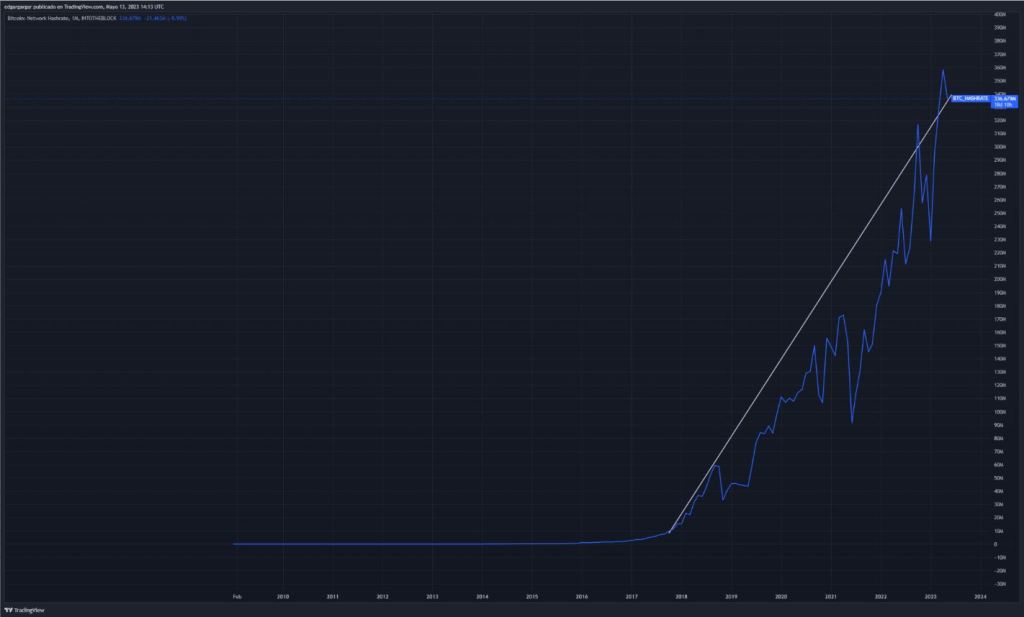
The Bitcoin network has become a very powerful network as we can see in the total computational power used in the entire network.
The number of users who store Bitcoin is also growing (blue line) and the trend of investors is also upward (orange line).

Bitcoin was postulated from the very beginning as an alternative to the traditional financial system, and there is no denying its success. The decentralization, the rules it has that are transparent and cannot be modified by anyone, and the open way in which it was created make it the first decentralized system and the leader of all existing ones to date.
But Bitcoin is not without its points of improvement and controversies. It is a good system for storing value, but not for instantaneous transactions of mass use. To provide Bitcoin with this functionality, a second network called Lighting has been designed that allows this to be done also in a decentralized way and that implements it in such a way that the transactions that occur can be registered in the Bitcoin network itself. Additionally, other level 2 networks have been appearing that allow other functionalities beyond those of Bitcoin, but taking advantage of its power.
Of course, other decentralized networks have emerged, but Bitcoin retains a market value close to half of the total of all cryptocurrencies.

In this 2023, new solutions have proliferated that allow storing information in the database of Bitcoin transactions, expanding the information that it supports and that we could call level 1.5 networks because they use the Bitcoin blockchain and its external systems at the same time. This way, NFTs or files can be registered on the Bitcoin network, increasing its use, but also its congestion and the costs for each transaction. This generates a new dilemma that we are going to discuss next with our fictional characters Rob Keys and Joana Grande.

Rob Keys:
The Bitcoin network is very powerful and secure. It is also open and anyone can use it. It makes perfect sense to use it for more things. To register images, art, any document that you want to prove your authorship, contracts, etc. All this is normal because what is saved cannot be modified and the date on which it was done is recorded, which is essential for all these new cases.
The fact of operating with the network and registering transactions requires the payment of commissions to the miners which makes it unprofitable to use it as a giant database where to store anything. It’s not going to come to that, but it does bring more benefits to the network and allows miners to get more profitability.
Joana Grande:
I think that this generates more problems than benefits to Bitcoin. While the mentioned use cases are interesting and of value, the Bitcoin network is not the best support for them. The basis of Bitcoin’s success is that it perfectly fulfills its purpose of exercising as a very good and free monetary system. The first Bitcoin block generated by its creator, in fact, has a message regarding bank bailouts stored. Its purpose is that, to be a good alternative financial system to the existing one and improving the previous one.
These new use cases, such as that of NFTs, have generated an initial boom but also, consequently, an increase in commissions and pending transactions. The very use of Bitcoin for what it really is, is in danger, Users are not going to want to trade with high commissions, nor wait any longer for these to be confirmed. In the end, this will harm all the uses that are being carried out on the Network, reducing in their amount. This could lead to a flight of users to other platforms.
Rob Keys
The NFTs created on the bitcoin network improve those existing on other platforms. They are immutable, secure, offer privacy, are accessible at any time and all within a decentralized ecosystem.
In addition, the Bitcoin transactions registered on its blockchain tends to decrease since transactions that occur on other second-level networks such as Lightning are going to be registered in an aggregated form. Perhaps, after making 10 transactions on Lighning, a user decides to update his balance on the Bitcoin blockchain, to give an example. Improvements such as utreexo are also being developed that allow adding transactions by reducing the size of the data associated with them. Everything will converge that the bitcoin network will have many uses and its technology will support it. There will be challenges along the way, but Bitcoin’s progress is unstoppable.
Joana Grande:
I don’t think you can and shouldn’t ban the use of Bitcoin for anything, even to store images of dubious morality in your database as an example. But the users themselves will look for alternatives in the face of high commissions. The miners and the Bitcoin nodes at the moment require more storage space since the information of the NFTs makes the average size of each block increase, making it more expensive to store the history of the transactions. This leads to more commissions and as long as there are no solutions, the free market will decide.
Tod:
Throughout the history of Bitcoin, there have been several times that the Bitcoin code has been used, but with different variants to those applied by the team of developers, let’s say official. This generates a fork in which the transaction history up to that moment is coincident between Bitcoin and its alternative, but then each goes its own way. Do you think this may be the reason for more forks to appear?
Rob Keys:
It is lawful for this to be done and new ideas are always welcome. The Bitcoin code is open and thus its own community can share ideas and receive different proposals. For the time being, the Bitcoin proposal has continued to prevail. Its incentive system is more about collaborating with Bitcoin to support a fork that in principle should not provide better incentives to most members of the Bitcoin ecosystem, unless over time it was shown that what was not considered better in principle, then ended up being it. It would be something like the majority was not right.
Joan Grande:
We must always be in favor of freedom and freedom of choice. There are already other networks and projects for NFTs, such as for fast and massive Bitcoin transactions, and many others. That’s where there are endless future possibilities and where I think Bitcoin is not going to dominate because it has a technological tara. Other networks that are also very powerful and made specifically for those uses will be better. Bitcoin will remain for what it was created for. Let’s say that cobbler’s saying to your shoes.
More in detail, in 2012 Pay to Script Hash (P2SH) transactions were added to Bitcoin with a series of new functions such as multi-signature transactions. These are used by the counterparty protocol, in turn used by Stamps which is the most booming Bitcoin NFTs system currently. Stamps recommends low image resolutions to avoid high commission costs.
In 2017 SegWit or segregated witness is added to Bitcoin and in 2021 Taproot is incorporated. This has led to other improvements in Bitcoin such as increased privacy, but they have allowed protocols such as Ordinals for NFTs.
In addition to NFTs, the BRC-20 protocol allows the existence of several types of Tokens registered in Bitcoin.
As the existing technology below Bitcoin becomes more complex, it also becomes more difficult to manage the entire ecosystem. The size of each transaction and each block is getting bigger. I think the simpler, the better. In fact, there is now talk within the community of including improvements to filter Spam which could mean not allowing these new uses.
Rob Keys:
To comment on the BRC-20 tokens, that even their creator does not recommend their use due to the existence of another process considered more optimal called Taro, currently in development and awaiting judicial approval. Taro takes advantage of Taproot to use hashes that can reference even millions of transactions of an external Token within a Bitcoin transaction. This makes the impact on space and computing in the Bitcoin network small and, in addition, it is compatible with the second-level Lightning network, allowing fast and impact-free transactions in the Bitcoin level 1 network.
Other protocols such as RGB are also compatible with Bitcoin and Lighning and allow smart contracts to be executed outside the blockchain.
I believe that technology is advancing and it is possible to face new challenges.
Tod:
Thank you very much. Of course there is a great controversy on this issue. We will talk more about crypto in the future and at the necessary level of detail. The next episode will be about energy.

 YOUR MARKET ANALYSIS SITE
Deja un comentario